
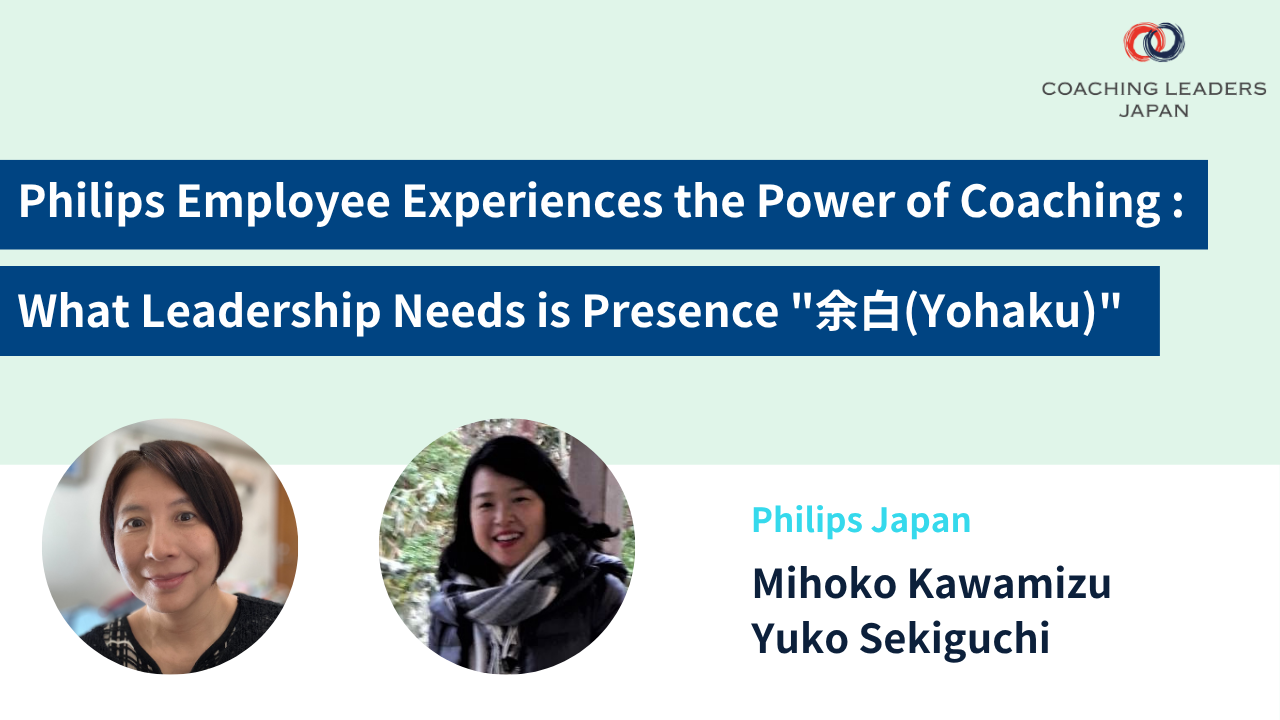
Philips Employee Experiences the Power of Coaching: What Leadership Needs is Presence”余白(Yohaku)”
2026年1月20日

Philips
| Industry | Healthcare Technology |
|---|---|
| Background | |
| Results |
Introduction
Coaching Leaders Japan, founded in 2020 and led by Rina Sakuraba, has coached over 1,000 executives across diverse industries. The organization bridges Eastern philosophy and modern coaching to support sustainable leadership and cultural transformationWhy Global Companies Choose Ontological Coaching
Ontological coaching focuses on experiential learning—where leadership transformation occurs not just in the mind, but through physical and emotional awareness, allowing leaders to align their actions with their authentic presence and values.PHILIPS: Embracing Coaching Culture Organization-Wide
In this article, we introduce a case study of how Coaching Leaders Japan supported the use of coaching at the Japanese branch of a global company.
Company Overview:

-
Number of Employees: 2,000 (Japan)
-
Industry: Healthcare Technology
-
Background for Implementation:With 2,000 employees in Japan, Philips introduced coaching to support employees preparing for promotion. The aim was to shift focus from performance-driven leadership to personal growth and relational trust. The results? Improved self-awareness, better team relationships, and enhanced leadership adaptability.
-
Results After Implementation: Through embodied learning, self-awareness deepened, relationship quality improved, and trust with subordinates and leadership flexibility increased
Ms. Kawamizu’s Leadership Philosophy: Expanding Possibilities
At Philips Japan, Ms. Kawamizu demonstrated exceptional leadership by supporting team members at critical career junctures. When Ms. Sekiguchi faced the challenging decision between deepening technical expertise or transitioning into management roles, Ms. Kawamizu’s guidance proved invaluable. Ms. Kawamizu: “Ms. Sekiguchi was facing a crossroads between deepening her specialized expertise, which she had cultivated over many years, and taking the management path as she anticipated promotion to a higher position. I believe that leadership is not something tied to job titles, but something that should be demonstrated in project management, coordination between departments, and all situations where people collaborate. I encouraged her to take this coaching program, hoping she would further expand her possibilities and be able to demonstrate leadership with confidence, regardless of which path she chose.” Her core belief that “leadership is not tied to job titles” reflects a modern understanding of how influence and impact can emerge at any organizational level. This philosophy creates an environment where team members feel empowered to explore new paths and develop capabilities they might not have discovered on their own.Ms. Sekiguchi Yuko: Navigating Career Transformation
Ms. Yuko Sekiguchi serves as Compliance Officer in Philips Japan’s Legal Compliance Department, bringing years of specialized expertise to her role. Standing at a pivotal point in her career, she was contemplating the transition from result-focused approaches to more people-centered leadership styles. Her previous experiences managing multiple subordinates had taught her valuable lessons about the complexities of adapting leadership styles to individual personalities, informing her future leadership approach. Ms. Sekiguchi: “I knew the term ‘coaching,’ but honestly, I didn’t have a clear image of what it specifically involved. However, when I received the suggestion from Ms. Kawamizu, I had been feeling the need for leadership and further growth, so I decided to take the program without hesitation. I have always been able to approach my work with passion. However, I felt my consciousness was too focused on producing results and completing projects, and I sensed I was lacking in perspective toward people. As I move to higher positions, I felt I needed a more people-centered approach.”The Ontological Difference: Beyond Traditional Training
Unlike conventional classroom training, ontological coaching uses movement and theatrical methods to deepen self-awareness. Participants uncover unconscious habits, like body posture or tone, that influence how they’re perceived as leaders.Self-Discovery Through Movement: The Body Knows Your True Self
Through the coaching process, Ms. Sekiguchi made crucial discoveries about her unconscious physical patterns. As she explained, “Ontological coaching incorporates the method of ‘using the body,’ which was completely different from traditional classroom training,it was truly a series of surprises. I realized that emotions and body movements are connected, and by using my body, I was able to understand myself more deeply.” The workshops allowed her to objectively observe habits she usually fell into when relying on words and logic. She described learning the perspective of a “big eye (observer’s eye)” looking down from above, as if another self was watching from above. By increasing the points where she could notice her own state, she truly felt the importance of always being conscious of what kind of self she was being. In this process, she discovered a particular habit of unconsciously leaning forward when trying to convey something to someone, potentially creating unintended pressure for others. With this awareness came the ability to consciously adjust her approach depending on the situation, whether by taking a step back, calming her mind through meditation, or taking deep breaths. She also noticed her tendency to shift into “task mode” during busy or stressful times, potentially treating team members in a directive rather than collaborative manner.From “Doing” to “Being”: Creating 余白(Yohaku)
The Importance of “Being”: The coaching process illuminated a fundamental principle, leadership effectiveness emerges not just from actions, but from one’s way of being while taking those actions. The concept of ‘Yohaku’ —intentional space— emphasizes creating room for reflection, dialogue, and trust. Ms. Sekiguchi learned that leadership isn’t about doing more, but about how you ‘are’ while leading Ms. Sekiguchi: “I realized that to grow as a leader, it’s important to create ‘余白(Yohaku)’ to promote subordinates’ growth. And I learned that having a stable way of being—’what kind of self am I being?’, is important, as it enables you to build good distance and relationships with subordinates.” She learned to implement a new four-step process that includes observing the other person well, listening carefully to what they’re seeking, conveying only what’s necessary while watching their reactions, and creating time for them to ask questions. This approach recognizes that trust is built through the quality of presence and attention leaders bring to relationships, not just through providing answers or constant action.What Changed at Philips: Organizational Impact
The coaching not only transformed Ms. Sekiguchi’s leadership style but also influenced Philips Japan’s broader organizational culture. Her shift from directive management to supportive engagement fostered open communication and innovation. The changes in Ms. Sekiguchi’s leadership style began influencing the broader organizational culture at Philips Japan. As Ms. Kawamizu observed, “From Ms. Sekiguchi’s feedback, I feel she is truly receiving positive influence. If we only seek results in work, there would be no need for people in organizations. The process of multiple people being involved together is extremely important, and that’s where the greatest value lies. Whether leaders recognize this and act accordingly makes a huge difference and greatly affects the consciousness and motivation of members involved.”The Future of Leadership Development
The success at Philips Japan demonstrates how ontological coaching principles can be adapted across different cultural contexts while maintaining their transformational power. Organizations interested in implementing this approach can begin with assessment of current leadership culture and challenges, followed by introduction of embodied learning methodologies, development of coaching capabilities within existing leadership teams, and creation of systems supporting ongoing growth and reflection. Coaching Leaders Japan offers various collaboration models, from intensive leadership development programs to ongoing coaching support, all designed to create sustainable transformation rather than temporary improvement. The ultimate goal extends beyond individual leader development to creating organizational cultures that continuously evolve, adapt, and thrive in increasingly complex business environments. As Ms. Kawamizu noted, ‘When individuals change how they show up, the entire organization evolves’About Philips Japan
Philips Japan Co., Ltd., established in 1953 as the Japanese entity of Royal Philips, aims to realize better health and fulfilling lives for people through innovative technology. Main business areas span widely across medical imaging, ultrasound diagnostics, image-guided therapy, patient monitoring, health informatics, sleep and respiratory therapy, and personal health. As a leading company in health technology, we are working to solve medical and health issues in Japan’s rapidly aging society. We have approximately 2,000 employees in Japan and operate business across about 70 locations. Website: https://www.philips.co.jp/Share this article


